Chapter 02 / Shoreline design
Buildings Along the Contour
The quality of a waterfront stay is often found in the section drawing: the route from a room to a terrace, a bank and the changing water below.
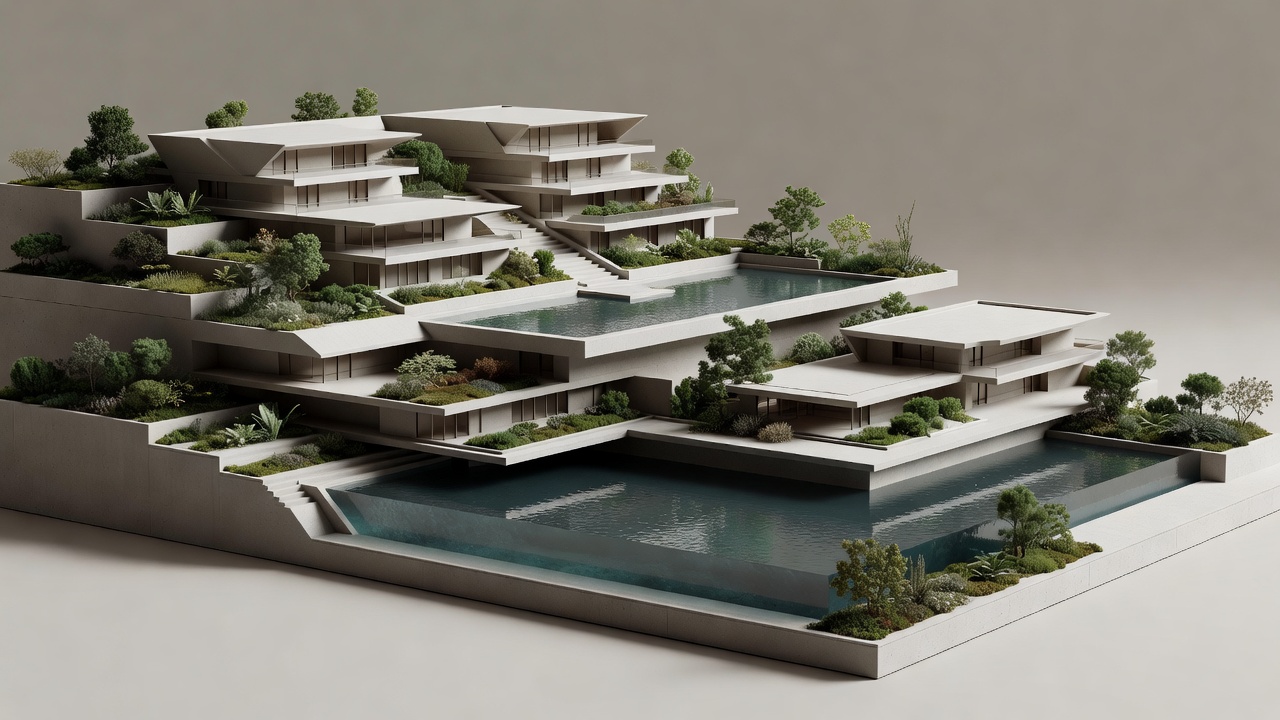
Separate the view from the address
“Waterfront,” “lakeside” and “reservoir view” describe different relationships with the shore. A hotel can face the water across a road, stand above a steep bank, or share access with a public recreation area. None of those arrangements is necessarily disappointing. Problems arise when a traveller imagines a private beach and encounters a long descent instead.
Start with a simple sequence: room, corridor, lift or stairs, terrace, path and water. Ask where each part of that journey lies. A site plan or a clear explanation is often more useful than a carefully cropped photograph. If mobility or easy swimming access matters, request details before choosing a room category.
Follow the slope
Mountain shorelines rarely offer a level building site without intervention. Hotels may step down a contour, occupy an existing village building, or sit on a constructed platform. These choices affect views, circulation and how much ground has been altered. A low roofline seen from the road can conceal several levels on the water side.
Thoughtful design works with this section rather than pretending it is flat. Sheltered landings, resting places and clear routes can make a hillside generous to guests. Conversely, a striking lobby may say little about the effort required to reach a room or a restaurant. Ask whether every stage of your intended route is step-free, not merely whether the hotel has a lift.
Luxury can be the ease of reaching a quiet terrace, not the amount of glass between a bed and the mountains.
Design for a moving edge
A reservoir’s usable edge can shift both vertically and horizontally. On a shallow bank, a modest change in height can expose a broad strip of land. A floating structure may accommodate some movement, but it still requires safe access and permission to operate. A fixed terrace can remain attractive while losing its immediate connection with the water.
For travellers, the best design response is usually adaptability rather than spectacle. Look for comfortable outdoor spaces that do not depend on one exact water level, clear information about seasonal facilities and alternatives when a pontoon or beach is unavailable. A property should distinguish its permanent amenities from activities operated by someone else.
Read light, shade and weather
Orientation affects the room throughout the day. A broad reservoir-facing window may bring a beautiful morning reflection, intense afternoon heat or glare that makes the terrace less comfortable than expected. Mountains can also shade a site earlier than a map suggests. Balconies, shutters, overhangs and opening windows therefore deserve as much attention as the view itself.
Ask how the room is cooled and ventilated, whether external shading is provided and whether outdoor seating is sheltered from wind. In cooler periods, generous glazing can still feel comfortable when the building envelope and heating are well considered. Architectural photographs rarely tell you how these systems perform during the season you intend to visit.
Notice what remains shared
Shorelines can carry public paths, fishing access, maintenance routes and community recreation. A luxury hotel does not automatically own or control the water beside it. Respecting these shared uses can make the destination richer: a village promenade or public path may be part of what gives the setting its character.
Before booking, ask which outdoor areas are reserved for guests and which are public. Also ask about delivery access, roadside noise and the location of boat facilities. A panoramic suite above a lively launch area offers a different atmosphere from a sheltered room facing a quiet inlet. Neither should be sold through the same unqualified promise of seclusion.
| Description | What it may mean | Useful follow-up |
|---|---|---|
| Reservoir view | Water visible from some part of the room | Full or partial view, seated or standing? |
| Private terrace | A guest-only outdoor area | Overlooked, shaded and sheltered? |
| Water access | A route to an authorised activity area | Steps, distance, season and supervision? |
Choose comfort that belongs to the place
Material choices can help a building settle into its setting, but stone cladding and timber interiors do not by themselves prove environmental care. Look also at repairability, summer comfort, lighting and drainage. A discreet building with well-managed runoff may respond more responsibly to the reservoir than a dramatic terrace that sheds water directly down the bank.
For inspiration, compare the different landscape scales around Lac de Serre-Ponçon, the Zillergründl reservoir and the Kaprun high-mountain reservoirs. These places are not interchangeable hotel districts, and some are better understood as excursion landscapes. The useful lesson is the same: judge a building in relation to its actual terrain, not an abstract idea of alpine luxury.
Let the plan guide the booking
Make a short list of needs: level access, quiet sleeping, shade, a usable terrace or a dependable swimming alternative. Send it directly to the property and keep the written response. Current room-specific information is more useful than a general claim that the hotel suits every traveller.
Then consider the journey to the upper shore. Even a beautifully resolved building can be a difficult choice if its arrival route conflicts with your plans. Good hospitality begins before the door and continues beyond the window.